


The West Virginia “Washout”: How to protect your VW’s undercarriage from mud and debris after a summer storm on rural Clarksburg roads.
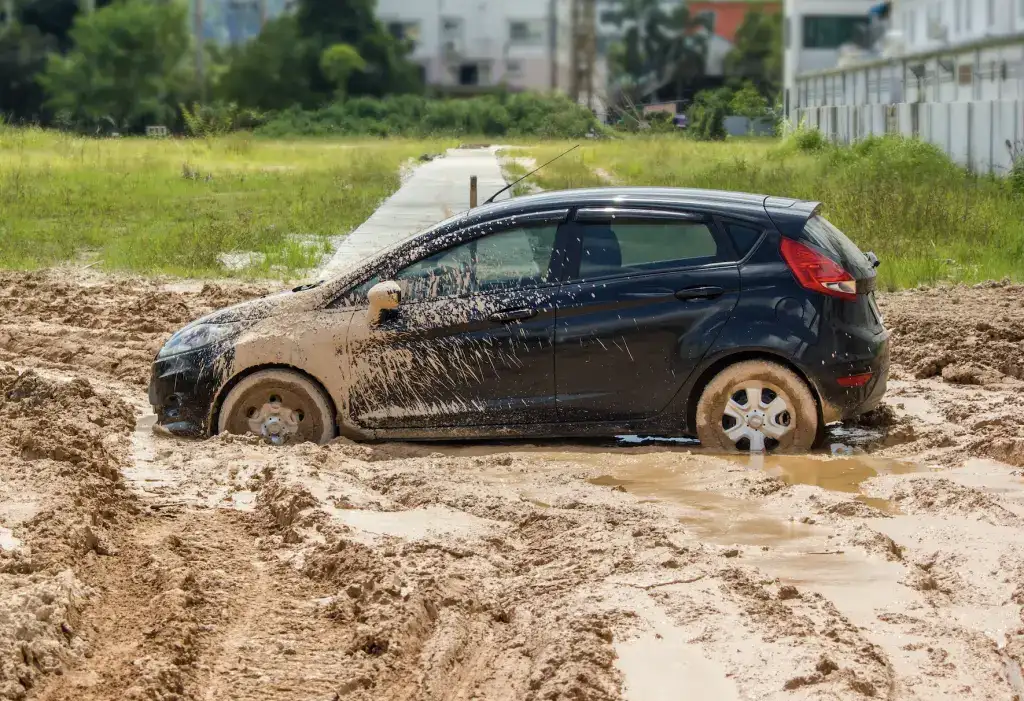
There’s a particular kind of road condition that only locals understand — the kind that shows up twenty minutes after a summer storm rolls through Harrison County, where a perfectly drivable gravel road becomes a moving slick of mud and loose stone that coats everything underneath your vehicle from the front splitter to the rear differential cover.
The roads around Clarksburg don’t all behave the same way in heavy rain. Paved surfaces on US-50 drain reasonably well. But the network of rural and semi-rural roads that branches off toward Lumberport, Shinnston, and out past Quiet Dell tells a different story. Those roads collect runoff from surrounding hillsides, channel it across the driving surface, and deposit a mixture of clay-heavy mud, gravel, and organic debris directly onto passing vehicles. For Volkswagen owners who drive those roads regularly, or who get caught on them during an unexpected storm, what happens to the undercarriage afterward matters more than most people realize.
What Summer Storm Runoff Actually Deposits on Your Undercarriage
West Virginia’s soil composition in Harrison County leans heavily toward clay. Clay-based mud behaves differently from sandy or loamy road debris. It adheres more aggressively to metal surfaces, dries into a dense, hard layer that traps moisture against whatever it’s stuck to, and holds road salts and organic acids from decaying vegetation against the undercarriage for weeks after the initial exposure. A single drive through post-storm conditions on a road like Meadowbrook Road or the back stretches off Jerry Dove Drive can leave a coating that takes active effort to remove.
That trapped moisture is the core problem. Modern VW undercarriages use a combination of galvanized steel, aluminum components, and protective coatings to resist corrosion, but those protections work best when the surface can dry between exposures. Mud that packs into the frame rails, suspension cradle, and subframe pockets creates a persistently wet environment that accelerates oxidation in exactly the places that are hardest to inspect without lifting the vehicle.
Beyond rust, packed debris causes mechanical issues. Mud that accumulates around brake components affects heat dissipation. Debris that packs around CV axle boots can cause premature wear on the boot material, and a torn CV boot leads to grease loss and eventual joint failure. Stone chips embedded in undercoating create entry points for moisture that the coating was designed to prevent.
The Components Most Vulnerable on a VW After Rural Road Exposure
Volkswagen’s platform architecture, particularly on Golf, Jetta, Tiguan, and Atlas models, places several components in positions that collect road debris efficiently. The subframe that carries the engine and front suspension sits low and forward, directly in the path of anything the front tires kick up. The multi-link rear suspension on most current VW models has a network of control arms, bushings, and mounting points that trap mud and hold it against metal surfaces.
Heat shields around the exhaust system are another accumulation point. These thin metal panels are positioned close to the exhaust components they protect, which means mud that packs between the shield and the exhaust pipe sits in a high-heat environment that cycles repeatedly between wet and extremely dry, accelerating both corrosion of the shield and degradation of any rubber components nearby.
The fuel tank skid plate and underbody panels that VW uses on many models to improve aerodynamics and reduce road noise are effective at protecting what’s above them, but they also create enclosed spaces where mud and moisture accumulate out of sight. A vehicle that looks clean from the side can be carrying a significant mud load in those enclosed underbody channels.
Thomas Briggs, a senior technician at Volkswagen Clarksburg, sees this pattern consistently through summer and into fall. “The vehicles that come in with the most undercarriage damage aren’t always the ones that look dirty on the outside. It’s the ones where mud got packed into the enclosed panels and sat there for weeks. By the time we get them on the lift, there’s active rust starting in places that should have been protected for years longer.”
How to Address Undercarriage Exposure After a Storm
The window between a rural road exposure and the onset of moisture-related damage is shorter than most drivers expect. Mud that’s still wet is significantly easier to remove than mud that has dried and bonded to the undercarriage surface. Ideally, a high-pressure rinse of the undercarriage should happen within 24 to 48 hours of significant rural road exposure, before the clay-heavy mud West Virginia roads produce has fully cured against the metal.
A standard drive-through car wash won’t accomplish this. The undercarriage spray systems on most commercial washes aren’t positioned or pressured to reach the enclosed subframe pockets, the area behind the rear axle cradle, or the spaces between underbody panels where the most problematic accumulation occurs. A self-service bay with a high-pressure wand used specifically on the undercarriage from multiple angles is more effective, and a professional undercarriage flush at the dealership using dedicated equipment covers the areas a wand can’t reach.
After rinsing, inspecting the undercarriage for torn CV boots, cracked underbody panels, and any areas where the protective coating has been chipped or scraped is worth the time. Stone impacts on rural roads in Harrison County are frequent enough that coating damage after a storm drive is common rather than exceptional. Small chips in the factory undercoating are straightforward to address when caught early. Left unaddressed, they become rust initiation points that spread beneath the surrounding coating and are significantly more involved to remediate.
Protective Measures Worth Considering for Regular Rural Drivers
For Volkswagen owners who regularly travel rural Harrison County roads, a few protective measures make a meaningful difference in long-term undercarriage condition. Here’s what the service team at Volkswagen Clarksburg recommends for drivers who encounter post-storm conditions regularly:
- Undercoating application: A rubberized or wax-based undercoating applied over the factory coating adds a sacrificial layer that takes stone chip and moisture damage before the factory protection does. Reapplication every two to three years maintains effective coverage. Cost at the dealership typically runs $150 to $300 depending on the product and vehicle size.
- CV boot inspection at every oil change: CV boots on rural road vehicles wear faster than the standard interval suggests. A torn boot found early means a boot replacement at $80 to $150. A torn boot found after joint contamination means a CV axle replacement at $300 to $600 per side.
- Underbody panel checks after significant storm exposure: The plastic underbody panels on most current VW models can crack or dislodge from stone impacts. A panel that’s partially detached creates aerodynamic lift at highway speed on I-79 and collects debris more aggressively than an intact panel.
- Heat shield inspection: Corroded or rattling heat shields are a common finding on vehicles with significant rural road exposure. Replacement runs $100 to $250 per shield and prevents the exhaust component damage that follows when a shield fails completely.
The 30-Day Action Plan for Clarksburg VW Owners
If the vehicle has been through summer storm conditions on rural Harrison County roads and hasn’t had an undercarriage inspection since, scheduling one at the next service visit is the most useful near-term step. The inspection takes less than 30 minutes on the lift and gives a clear picture of what the undercarriage is carrying and where the protective coating stands.
Between now and that appointment, check the wheel wells after any rural road drive. The wheel wells on Golf and Jetta models accumulate mud that migrates toward the suspension components behind the liner, and packed mud in that area is visible without lifting the vehicle. If the mud has dried to a hard layer, it’s been there long enough that a professional flush rather than a garden hose is the appropriate response.
Pay attention to any new sounds that developed after a storm drive. A clicking sound during turns that wasn’t there before points to CV joint exposure from a compromised boot. A rattling from underneath at idle or low speed often indicates a heat shield that took a stone hit and is no longer sitting flat. Either of these warrants a look before the next extended rural road trip.
Harrison County’s summer storms aren’t going to stop, and the roads that branch off toward Lumberport and Quiet Dell aren’t going to get smoother. Keeping the undercarriage clean and the protective coating intact is what separates a VW that handles those conditions for years from one that starts showing rust in places it shouldn’t. Bring it in for an undercarriage inspection and let the team at Volkswagen Clarksburg assess what the roads have done. Schedule your appointment or stop in at 730 Lodgeville Rd, Bridgeport, WV 26330.
0 comment(s) so far on The West Virginia “Washout”: How to protect your VW’s undercarriage from mud and debris after a summer storm on rural Clarksburg roads.