


The 2026 VW Tiguan Gets a Refresh: What Clarksburg Drivers Need to Know About Its New Turbo Engine
Last month, a 2022 Tiguan came in from a Bridgeport owner who had been ignoring a persistent hesitation on acceleration since buying the vehicle used. He assumed it was normal break-in behavior and kept driving it through the hills off US-50 and onto I-79 for his daily commute. After 14,000 miles of neglect, the high-pressure fuel pump failed, and the turbo system showed signs of oil starvation from irregular oil changes. The fuel pump replacement alone ran $1,100. The catch? Staying current with VW’s recommended synthetic oil interval and a basic fuel system inspection would have cost him around $180.
That story isn’t unusual. At Volkswagen Clarksburg, we see variations of it regularly, especially when drivers inherit a turbocharged vehicle without fully understanding what makes these engines different from naturally aspirated ones.
Now, with the 2026 VW Tiguan rolling out with a refreshed turbocharged inline-four, we want Clarksburg, Bridgeport, and Harrison County drivers to go in informed. This isn’t just a cosmetic refresh. The new powertrain brings real changes that affect how you drive it, how you maintain it, and what to expect over the long haul.
Whether you’re already a Tiguan owner, considering a trade-in, or shopping new, here’s what actually matters.
What’s New Under the Hood in the 2026 Tiguan
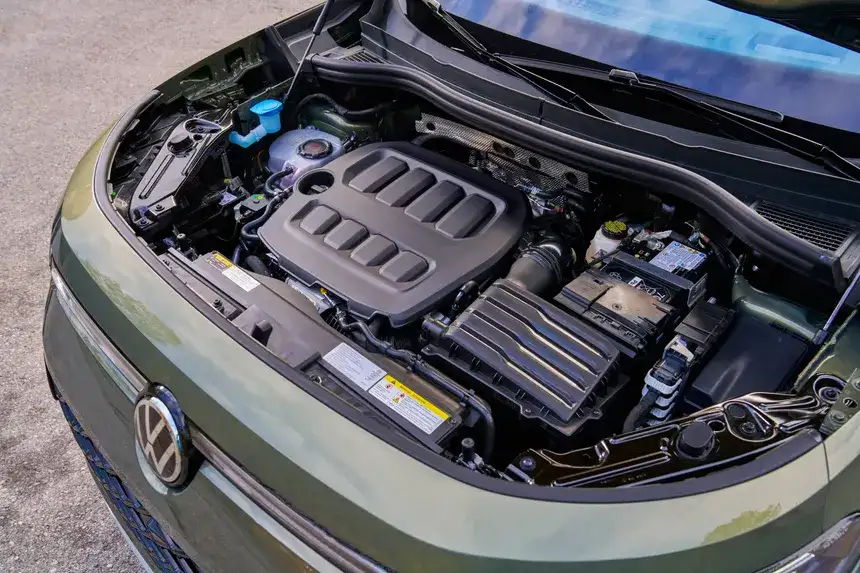
Volkswagen’s 2026 Tiguan arrives with an updated 2.0-liter TSI turbocharged engine, tuned for improved low-end torque and more responsive throttle delivery across everyday driving conditions. This matters especially in West Virginia, where elevation changes, winding two-lanes like WV-20, and the long grades on I-79 between Clarksburg and Morgantown demand a lot more from a drivetrain than flat highway cruising.
The revised engine produces stronger pull from lower RPMs, which translates to noticeably easier merging on the fast-moving interchange near Bridgeport and more confident passing on the rural routes around Shinnston and Salem.
The TSI Engine and What “Turbo” Actually Means for You
A turbocharged engine uses exhaust gases to spin a compressor that forces more air into the combustion chamber, producing more power from a smaller displacement. The tradeoff is that turbo engines run hotter, depend more heavily on clean oil for lubrication, and require premium-grade synthetic oil to protect the turbocharger bearings.
This isn’t a warning, it’s just the reality of the technology. Understand it, maintain accordingly, and the TSI engine is genuinely durable. Ignore it, and you’re looking at a repair bill that nobody wants.
Fuel Economy Improvements Worth Knowing
The 2026 refresh also brings modest fuel economy improvements over the previous generation, with combined estimates in the 28-30 MPG range depending on trim and driving profile. For Harrison County commuters putting 15,000 or more miles a year on their Tiguan, that adds up meaningfully at the pump over a three-year ownership period.
Why Turbo Engine Maintenance Is Different in West Virginia
Here’s something that doesn’t make it into most car commercials: turbocharged engines in mountainous, variable-climate regions like north-central West Virginia age differently than the same engine would in flat, temperate conditions.
Winter temperatures in Clarksburg regularly drop into the teens and single digits. Cold starts are harder on turbo systems because oil thickens overnight and takes longer to reach the turbocharger. Summer heat combined with the stop-and-go congestion near US-50 and the Benedum Airport corridor puts sustained thermal stress on the engine oil. And the salt and brine that WVDOT uses aggressively on I-79 and US-48 through the winter months create an oxidizing environment that accelerates wear on any exposed components.
The Oil Change Reality for TSI Engines
Volkswagen specifies full synthetic oil for the 2026 Tiguan, and the interval is typically 10,000 miles under normal driving conditions. But “normal” in VW’s definition doesn’t account for repeated short trips through Bridgeport in January, or idling in traffic on WV-131 during a snowstorm.
If your driving skews toward shorter trips, cold-weather starts, or towing, a 7,500-mile interval with full synthetic is a smarter approach. The cost difference is minimal. The protection difference is significant.
A customer came to us last winter after purchasing a 2023 Tiguan from a private seller in Clarksburg. She had no service history for the vehicle and had driven it for six months on what turned out to be heavily degraded oil. The turbocharger had developed a rattle at idle, a classic symptom of bearing wear from oil starvation. Repair cost: $2,400. Two synthetic oil changes at the proper interval would have been $160 total.
Warning Signs Your 2026 Tiguan’s Turbo System Needs Attention
Catching issues early with a turbocharged engine is far less expensive than addressing them after the fact. These are the signs worth taking seriously:
Blue or gray smoke from the exhaust at startup or under acceleration can indicate the turbocharger seals are allowing oil into the combustion chamber. This is a progressive problem that won’t resolve on its own.
Hesitation or lag on acceleration that wasn’t there before, particularly when merging or climbing grades, can point to a boost pressure issue, a clogged intercooler, or early turbo wear.
A whining or whistling sound from the engine bay under load is one of the earliest audible signs of a turbocharger bearing beginning to wear. Don’t wait on this one.
Oil consumption between changes is worth monitoring. Some consumption is normal in high-performance turbo engines, but if you’re adding more than a quart every 3,000 miles, it warrants a professional look.
The check engine light with a boost-related code should always be diagnosed promptly. P0234, P0299, and related turbo codes are common, and some have inexpensive fixes if caught early.
If you notice any of these in your Tiguan, bring it in for a diagnosis before a small issue becomes a costly repair.
The Real Cost Comparison: Maintenance vs. Repair
This is where it helps to see the numbers side by side.
Skipping proper turbo-focused maintenance for 30,000 miles:
- Deferred synthetic oil changes (using conventional or extended-interval oil): saves roughly $120
- Skipped fuel system service: saves $90
- Ignored boost system inspection: saves $60
- Total “saved”: $270
- Turbocharger replacement when it fails: $2,200 to $3,500
Staying on schedule for 30,000 miles:
- 3 full synthetic oil changes at $80 each: $240
- One fuel system service: $90
- One turbo and boost inspection: $60
- Smart total: $390
- Avoided repair cost: $2,200 to $3,500
Your savings from proper maintenance: $1,800 to $3,100. That’s not a hypothetical. That’s what we see play out in our service bay on Lodgeville Road on a regular basis.
What the 2026 Tiguan Refresh Means If You’re Trading In
If you currently own a 2022-2024 Tiguan, the 2026 refresh creates a compelling trade-in window, especially if your current vehicle is in good service condition. Clean maintenance records, no deferred repairs, and documented oil change history all add value at appraisal.
A Tiguan owner from Shinnston came in last fall to explore a trade toward the updated model. His 2021 had 48,000 miles on it with full VW service history from our Lodgeville Road location. The documented maintenance history added measurable credibility to the appraisal and contributed to a stronger trade value than comparably mileaged vehicles without records.
The lesson isn’t complicated: the same habits that protect your engine also protect your resale position. 🔧
“We still see people come in assuming that because their car ‘seems fine,’ the oil is fine too,” says Marcus Hendley, Lead Service Technician at the Lodgeville Road location. “Turbo engines don’t give you much warning before something goes wrong. Check your oil level monthly, use full synthetic, and don’t push past your change interval. Those three things alone prevent the majority of what we see come through here.”
Your 30-Day Tiguan Turbo Engine Check
This week: Check your oil level and condition. Pull the dipstick cold, before starting the engine, and look at both the level and the color. Fresh full synthetic oil is amber and translucent. Dark brown or black oil that’s due for a change won’t protect your turbocharger the way it should. If you’re within 1,000 miles of your service interval, go ahead and schedule it now.
Within two weeks: Listen to your engine during your normal commute on I-79 or US-50. Pay attention specifically at startup and under load when accelerating up grades. Any new whining, rattling, or hesitation that wasn’t present before is worth noting. A quick turbo health check during your next oil service costs nothing extra and takes about ten minutes.
By month’s end: Pull up your service history or contact our service department on Lodgeville Road to confirm you’re current on fuel system maintenance and that your air filter is clean. A clogged air filter reduces the oxygen supply to your turbo engine and forces the system to work harder under load, especially relevant during the pollen-heavy West Virginia spring months.
These three checks take less than 30 minutes total but can add years to the life of your TSI engine and prevent the kind of repair bills that derail a vehicle budget.
Taking care of your Tiguan now, before a problem develops, is always the right call. The 2026 refresh is a genuinely strong evolution of the platform, and with proper attention it will serve Clarksburg-area drivers reliably through everything north-central West Virginia throws at it.
Schedule Your Tiguan Service or Test Drive Today
The Bridgeport owner from the opening of this post? He eventually traded in his repaired Tiguan and upgraded to a 2025 model. He’s now on a proper synthetic oil schedule and has his service reminders set. No more surprises, no more four-figure repair bills from preventable neglect.
The 2026 VW Tiguan is one of the most capable SUVs in its class for West Virginia driving conditions, and our certified Volkswagen technicians at the Lodgeville Road location know this platform inside and out. Whether you’re coming in for a first look at the 2026 model, scheduling your current Tiguan for a turbo system inspection, or exploring your trade-in options, we’re here to make it straightforward. 🚗
Schedule your service or schedule a test drive today by visiting our service department or booking online. You’ll find us at 730 Lodgeville Rd, Bridgeport, WV 26330.
Proper maintenance protects your investment, prevents the costly turbo repairs we see far too often, and ensures your Tiguan performs the way it was built to, through every commute, every season, and every mile of West Virginia road ahead.
0 comment(s) so far on The 2026 VW Tiguan Gets a Refresh: What Clarksburg Drivers Need to Know About Its New Turbo Engine