


Navigating Route 50 Incline Drops: Signs Your VW Tiguan Brakes & Fluid Need Service
Key Takeaways
- Route 50’s descents through the hills surrounding Bridgeport put sustained, repeated load on the Tiguan’s brake pads, rotors, and fluid in a way that flat, low-speed driving never does.
- Brake fluid absorbs moisture over time, lowering its boiling point and making it more prone to fade exactly when a long downhill stretch demands consistent stopping power.
- Warning signs like a soft pedal, a burning smell, or vibration under braking often show up first on grade descents before they become noticeable during normal driving.
- Ignoring early brake wear can turn a $100 to $180 inspection into a $700-plus rotor and caliper repair, or worse, a safety issue on a downhill stretch of Route 50.
Bridgeport drivers who regularly take Route 50 through the surrounding hills know that the descents aren’t gentle rolls, they’re sustained grades that ask a vehicle’s brakes to do real work for an extended stretch rather than the occasional stop-and-go braking of city driving. The Tiguan handles these descents well when its braking system is in good condition, but repeated descents on a brake system that’s overdue for inspection can expose weaknesses that don’t show up during normal, flatter commuting. A Tiguan that develops a serious brake issue from prolonged grade descent stress can face a rotor and caliper repair well over $700, compared to a straightforward inspection that costs a small fraction of that, and catching the warning signs early is what makes the difference between the two.
Why Downhill Grades Are Harder on Brakes Than City Driving
Braking on a flat road and braking on a sustained downhill grade are fundamentally different in terms of the heat generated. On a long descent, the brakes aren’t just making occasional stops, they’re often working continuously to manage the vehicle’s speed against gravity, especially if a driver relies heavily on the brake pedal rather than engine braking through a lower gear. That continuous engagement generates significant heat that builds in the rotors and pads over the length of the descent, rather than dissipating between isolated stops the way it would in typical driving.
Route 50’s descents through the hills around Bridgeport create exactly this scenario. A driver coming down from higher elevation toward town covers enough sustained downhill distance that a marginal brake system, one with slightly worn pads, aging fluid, or rotors that have already seen some wear, can start showing problems that simply wouldn’t surface during a normal week of local errands.
The Warning Signs Worth Paying Attention To
Brake problems often announce themselves gradually, and a descent like the ones along Route 50 tends to bring out symptoms before they’d otherwise be noticeable. Drivers should watch for:
- A soft or spongy brake pedal, which can indicate air in the brake lines or brake fluid that has absorbed enough moisture to compress under heat rather than transmitting pressure directly
- A burning smell after a long descent, suggesting the brakes have been working harder than they should, often due to pads that are worn thin or a caliper that isn’t releasing fully
- Vibration or pulsing felt through the brake pedal, which frequently points to warped rotors from repeated heat cycling
- A grinding or squealing noise under braking, typically indicating pads that have worn down to or past their wear indicators
- The vehicle pulling to one side during braking, which can suggest uneven pad wear or a caliper that’s sticking on one side
Any of these signs showing up specifically after a descent, even if the brakes seem to feel normal during flatter driving, is worth treating as an early warning rather than something to wait out.
Why Brake Fluid Condition Matters More Than Most Drivers Realize
Brake fluid is hygroscopic, meaning it naturally absorbs moisture from the air over time, even in a sealed system. As moisture content increases, the fluid’s boiling point drops, and that matters significantly during sustained braking on a grade, since the heat generated during a long descent is exactly the condition that can push degraded fluid past its effective boiling point. When that happens, the moisture in the fluid can vaporize, creating compressible bubbles in the brake lines that lead to that soft, spongy pedal feel, sometimes with alarmingly little warning.
This is part of why brake fluid should be flushed on a regular interval regardless of whether the pads and rotors show obvious wear. A Tiguan with fresh, low-moisture brake fluid handles sustained grade braking with a much larger safety margin than one running on fluid that’s several years old, even if both vehicles have similar pad and rotor wear.
What a Thorough Brake and Fluid Inspection Should Include
A proper pre-season or pre-trip brake check for grade driving should cover:
- Pad thickness measurement at all four corners, confirming there’s enough material left to handle sustained braking, not just routine stops
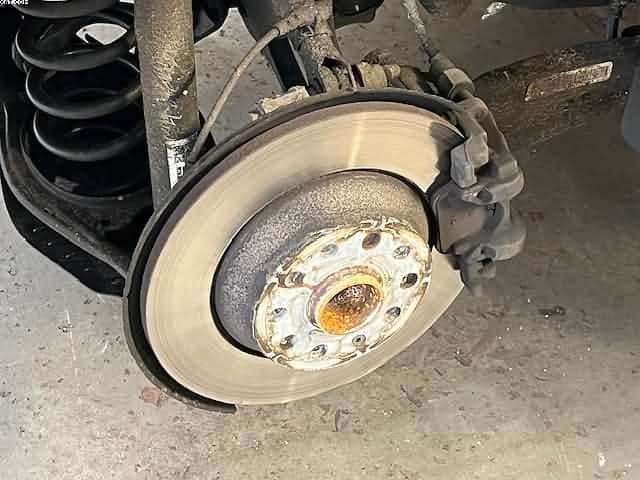
- Rotor inspection for warping, scoring, or thickness variation, checking for the kind of wear that develops specifically from heat cycling on descents
- Brake fluid moisture content test, measuring how much moisture the fluid has absorbed rather than simply checking fluid level
- Caliper function check, confirming calipers are fully releasing and not dragging, which would generate excess heat even under normal braking
- Brake line and hose inspection, looking for any signs of degradation that could affect fluid pressure under sustained use
The Cost of Catching Issues Early Versus Waiting
Comparing the numbers makes the case for addressing warning signs promptly:
- Brake inspection and fluid moisture test: typically $100 to $180
- Brake fluid flush, if moisture content is elevated: roughly $100 to $150
- Pad replacement (per axle), if caught at the wear indicator stage: commonly $150 to $300
- Rotor and caliper replacement after prolonged heat damage or neglect: frequently $700 to $1,200 or more depending on how many components are affected
Beyond the repair costs themselves, brakes that fade or fail on a downhill stretch of Route 50 represent a genuine safety concern, which makes this one of the clearer cases where a modest inspection cost is worth scheduling well before symptoms become severe.
Route 50’s grades are a regular part of driving in and around Bridgeport, and a Tiguan with well-maintained brakes and fresh fluid handles those descents with the margin of safety they’re designed to provide. A Tiguan showing any of the warning signs above, particularly after a downhill stretch, shouldn’t wait for the next scheduled service interval. Volkswagen Clarksburg, located at 730 Lodgeville Rd, Bridgeport, WV 26330 offers the brake inspection, fluid testing, and pad and rotor evaluation needed to keep a Tiguan’s braking system ready for Route 50’s grades, giving Bridgeport drivers confidence on every descent.
0 comment(s) so far on Navigating Route 50 Incline Drops: Signs Your VW Tiguan Brakes & Fluid Need Service